Putting away childish things

Jacob is my favourite biblical character thus far. He embodies the characteristics of a man who had his fair share of the salvation journey. In Genesis 27, he is the child of his mother, supplanting Esau for the blessing. Genesis 28 is his first encounter with the God of Abraham and Isaac, the first glimpse of what his life was about. In Chapter 29, he continues life’s sojourn to the place of stewardship in Laban’s house. Throughout Genesis 29 to 35, we read about his progression from a young trickster to an old wise man whose encounter with God changes his identity forever, culminating in his ultimate life testimony when he was passing the blessing to Joseph, as captured in Genesis 48:3-4.

Genesis 48:3–4 (Amplified Bible, Classic Edition)
And Jacob said to Joseph, God Almighty appeared to me at Luz [Bethel] in the land of Canaan and blessed me.
And said to me, Behold, I will make you fruitful and multiply you, and I will make you a multitude of people, and will give this land to your descendants after you as an everlasting possession.

When I read Jacob’s story, I see a man who struggles with life, culture, choices, destiny, obedience, stewardship, honour, and everything that living on this earth may bring to anyone. But the scriptures tell us of a man who found the place he may call home—the place God always called him to—the place of his encounters at Bethel.

As a young Christian at the university, in our beloved Makerere University Christian Union, I always looked forward to gaining more knowledge. ‘Epignosis’ and ‘Gnosis’ (and many other Greek words) were part and parcel of the sermon content we looked out for because we were young and grasping for the spectacular in a bid to show our prowess and prove our potential. It was indeed a glorious time; much of it was spent reading the New Testament and continuously immersing in Paul’s letters and his gospel. Gazing back at that time, I now understand why this was important. I see the significance of Christ being formed in us (Galatians 4:19), and I honour every labour that men put in for our growth.

Then came the time after university, when we leapt into the great expanse of the marketplace and nations, just as Jacob had to leave the covering of Rebecca, his mother, and his father’s house. It was inevitable that we dispersed after university; as scriptures elaborate in Ecclesiastes 1:4, ‘one generation passes away and another comes.’ From then on, I had to intentionally walk by the statutes, laws, judgements, testimonies, commandments and ultimately the fear of God, as I had so learned, and I had to ‘allow another to take hold of me.’

“Learning” Christ was wholesome. But, soon after, I had to ‘work out my salvation with fear and trembling’, because I was no longer in the presence of fellow Christians nor under the covering of University Christian Union leaders (whom we affectionately called Papas and Mamas) (Philippians 2:12). Therefore, another had to take hold of me—the Lord’s Spirit himself. God, in his faithfulness, has been and is still ‘working in me,’ as he does in all of his children, ‘both to will and to do.’ Teaching me principles through the lives of men like Jacob, some of which have become increasingly relevant to my salvation journey as I progress through young age towards maturity and sonship:

Discipleship
Possibly the most significant component of the journey. Jacob went into Laban’s house and learned how to raise cattle (Genesis 30:29), and this would be his testimony as his occupation (Genesis 47:3). Every Christian must become an apprentice to a system of soul-winning, follow-up, service, and patterns (Matthew 28:20). It is thus necessary to be planted in a church or ministry in order to be instructed (Psalms 92:13).

Stewardship
Genesis 30 and 31 outline the back and forth between Jacob and Laban’s family concerning the wealth of Laban–his cattle. Laban greatly prospered during Jacob’s tenure with him (Genesis 30:27–29), and the testimony of scripture is that Laban bore witness of increase because of Jacob’s stewardship.
We are all to be stewards of God’s mysteries (1 Corinthians 4:1-2), whether in employment, family, or ministry. Our way is the way of God—to be true to Him who called us into the fellowship of his dear son.
The Word of God, the Way of the Lord, is our way, and we are its custodians in this world. And because we are children of God, guaranteed to bear fruit if we abide in Him (John 15:1–15), the world will only recognise us by our fruit, whose manifestation it surely yearns for (Romans 8:19-22).

Instruction (And to be instructed (Jeremiah 6:8))
Heeding to godly counsel, convictions, testimonies, commandments, and laws that keep us in the way of righteousness and justice is important. Several aspects speak to any young person, including cultures, family, trends, the physical, and the economy. But only the Word of God can give us ‘light and life‘ (John 1:4, 8:12) and a sure inheritance. For Jacob, he made a vow (Genesis 28:20-22), whereby the Lord would be his God, and he followed it up with action (the paying of a tenth – Genesis 28:22). I believe that it is this conviction that got him through the difficult periods of his eventuality.

Contentment
The evil day is a surety beneath the sun (Ecclesiastes 12:1-7), the floods of ungodliness will appear someday (Psalms 18:4-5), and worries of all kinds will sneak in because of the sinful nature of this present time. It is good to be still and know that the Lord is God (Lamentations 3:27) and that he is the ultimate inheritance of the saints (Acts 20:32). You must carry contentment and a grateful heart along (1 Timothy 6:6).
After naming himself Esau (Genesis 27:19), Jacob had to eventually answer to his own name (Genesis 32:26-28). For in the acknowledgement of his identity and the unwavering acceptance of himself, his destiny was then truly blessed.

The Secret Place
The encounter at Bethel, where Abraham first raised an altar to the Lord (Genesis 12:7), was Jacob’s first stop on his journey away from home. During his life, the altar of his meeting with God, which he raised (Genesis 28:18-19), called to him and guided him to the blessing that was his inheritance.
As a Christian, you must learn to pray (Luke 18:1), seek God from a pure heart (Isaiah 55:6), meet him in his sacred tabernacle (Psalms 48:1), face to face (Isaiah 33:17, Job 19:27), and observe the beauty of his holiness (Psalms 27:4).

Jacob met God in his life and certainly fulfilled his mission, dying in Egypt at the beginning of the children of Israel’s sojourn there, as prophesied in Genesis 15:13. His life bears witness to the fact that he lived according to the God of his fathers and was buried alongside his people (Genesis 49:29-33). And now the Lord is Jacob’s God, speaking of the people who seek their God (Psalms 24:6).

Every man and woman must therefore put away childhood (Ecclesiastes 11:10), “embrace sound doctrine”, and “make full proof” of their life and destiny as God intended it in Christ Jesus (2 Timothy 4:3-5). And if you’re still unsure, remember those who, through faith, received a favourable report (Hebrews 11:2). And might I take the liberty to say – remember Jacob.

The Lord will help us, in the name of Jesus Christ. Amen.

The Waiting Room – While I wait

Waiting is hard! Anyone who has had to wait on the Lord for anything will testify to this. It will test every confession of faith, trust, and hope in God you have ever professed. It is even more challenging when other seemingly good options are available, but you must still wait on God’s will and His perfect timing.

Sarah illustrated this very well in the book of Genesis in the Old Testament. She waited so many years for a promised son and eventually got tired. One day, an idea came to mind; she went to her husband, Abraham, and offered a solution for their barrenness. Instead of waiting indefinitely with no assurance, her maid Hagar would bring the promise of a son to fulfilment. “Maybe I can have children through her(Genesis 16:2b), she said. Abraham, perhaps tired of the wait as well, listened to his wife, accepted the proposal, and went into Hagar; and thus, Ishmael was born. Genesis 16:3 So he went into Hagar, and she conceived.” However, in God’s kingdom, the child recognised as the promised son was Isaac, who came after the wait.

It has been many years since Abraham and Sarah’s story; however, I believe there will always be someone waiting on the Lord in every generation. Waiting for different reasons: a job, a business, a breakthrough, healing, marriage, a child, ministry, the voice of God – the list is endless.

In my earlier post, I wrote about three things that cause delay: ignorance, the devil, and God. In this post, I focus on the last part: waiting on God. This is for those waiting on the lord. I will list three things we should do while we wait on the Lord.

1. Do not lose your joy

The thing about a promise is that when it is first given, there is excitement, awe, and thanksgiving. But over time, the promise becomes a painful memory as days turn into months and months into years – a reason to question your sanity and whether it was God whom you heard speaking. And life is cruel. It will constantly demand results, and at some point, those doing well will deem you a failure. All this can cause you to be angry and disappointed in God, leading to a loss of joy. We always try to justify it; stating the reasons for our lack of joy and the bitterness that follows afterwards. But remember that whatever the devil can steal, he will steal, even if it is your joy.

However, in this kingdom, joy is strength. The joy of the Lord is your strength” (Nehemiah 8:10). Joy is a fruit of the Holy Spirit. When the Spirit of God gives it, it is independent of your current circumstances. In Matthew, Jesus teaches us something. Matthew 6:31-32 So do not worry, saying, ‘What shall we eat?’ or ‘What shall we drink?’ or ‘What shall we wear?’ For the pagans run after all these things, and your heavenly Father knows that you need them. While waiting, we can forget that God hears, knows, or He often responds in grand style, but God understands more than we think he does, and he is very determined to make glory come from our lives. The Bible calls him Faithful. Even with Ishmael already born, God still sent Isaac, the son of the promise. Therefore, while I wait, I do not lose my joy.

2. Remain in prayer

Luke 18:1 And He spoke a parable unto them to this end that men ought always to pray and not to faint. Prayer is a kingdom principle; there is no way around it. The German theologian and greatest force in the Protestant movement in Europe Martin Luther said, “I have so much to do that I shall spend the first three hours in prayer.” The results may not come after the first time that you say amen, but you press forward in prayer.

Sometimes there is an instruction to follow before the manifestation of what you have prayed for. You will receive this instruction only in the place of prayer. Notice the prophets in the Old Testament. The word of the Lord often came with instructions. Prayer is not just to talk to God but to hear what he has to say and listen for instruction.

Jeremiah 2:1-2 Moreover, the word of the Lord came to me, saying, “Go and cry in the hearing of Jerusalem, saying, “Thus says the Lord.”…

Isaiah 7:3 Then the Lord said to Isaiah, “Go out now to meet Ahaz, you and Shear-Jashub, your son, at the end of the aqueduct from the upper pool, on the highway to the Fuller’s Field.”

Ezekiel 3:1-2 Moreover, He said to me, “Son of man, eat what you find; eat this scroll, and go speak to the house of Israel.” So I opened my mouth, and He caused me to eat that scroll.

1 Kings 19:15 Then the Lord said to him: “Go, return on your way to the Wilderness of Damascus; and when you arrive, anoint Hazel as king over Syria.

All the verses above illustrate an instruction from the Lord for the prophets to carry on. Remember we are co-labourer’s with Christ therefore, we must know what role we play in that relationship. 1 Corinthians 3:9 For we are co-workers in God’s service; you are God’s field, God’s building. Prayer will guide us in the way to go. The gospel of Luke introduces a woman very briefly but her story carries an important message. Anna was a prophetess (Luke 2:36-38) who perceived that the savior would come in her time. While she waited for that appointed time, she dedicated her life to fasting and praying in the temple. Therefore, while I wait, I will pray.

3. Praise is comely

I have always wondered why every church service starts with praise and worship. I learnt that it is not just for singing and dancing; it is done in honour of our God. It is an acknowledgement of the one from whom all blessings flow. Sometimes he will place a song on your heart that will minister to you more than any other song in that season. It could be an old song or a new one that God is writing through you. While marching around the walls of Jericho, it was not prayer but blowing the trumpets and a loud shout that brought the wall of Jericho down. There is power in praise.

Consider David, the man God testifies about and says was a man after his own heart. Acts 13:22 And when He had removed him, He raised for them David as king, to whom also He gave testimony and said, ‘I have found David the son of Jesse, a man after My own heart, who will do all My will. One of his greatest secrets was praise. In the cave of Adullam, when he was hiding from King Saul, waiting for the appointed time to be king, he praised. When he was repenting from the sin of killing an innocent man and taking his wife, he praised. When his son Absalom overthrew him and took over the kingdom and he was in great distress, he raised a psalm of praise to the Lord. Therefore, while I wait, I will praise.

My heartfelt prayer is that we will not grow weary in the season of waiting on the Lord, but we shall have joy unspeakable, we shall remain in prayer and our lips shall be full of praise. For he has promised in Isaiah 40:31 that those who wait on the Lord. Shall renew their strength; they shall mount up with wings like eagles; they shall run and not be weary; they shall walk and not faint.

Selah

My King then spoke…

I was faced with a very hard decision a couple of weeks back. I had to make a choice between what God had in store for me and what the world offered me. To be fair, the only evidence I had of God’s promises was a dream and a prophetic word. Also, I was confident in what the goodness of the Lord is or at least I thought I was. The world presented security, stability, and status. The world gave me evidence which I could see  and touch. 

Honestly, I have faced similar decisions in the past, but this time I was shaken. I felt completely unstable, and everything I was waiting on the Lord for seemed unrealistic. I went back to my prayer journal to read my conversation with God regarding this matter, but I still did not feel confident in the promises of God. I was not as grounded in the will of God. I was more willing to compromise than ever before and I felt no conviction. I asked Jesus, “why has this decision been much harder for me to make? Why is my ground so unstable?”. My King then spoke…

Where your treasure is, there your heart will be. Guard your heart, for out of it flows the matters of life. Depending on where your treasure is, that is where your life will flow. Whatever you engage in will give the beat to which your life will dance. All decisions will seem normal and easy based on your treasure and the values you relate to in that season. If your treasure is on earthly things, your spirit will always struggle with My Will and be comfortable with the world’s offer. But when your treasure is in me, your spirit will be more confident in My Will and Direction and very uncomfortable with the world. You make many decisions based on feelings nurtured by knowledge. The informed decision is stamped by how you feel at that time and how you feel is nurtured by the information presented in season. You cannot control your feelings, but you can direct them by investing in me, as a treasure. Again, guard your heart for the matters of life flow from it. 

I am in awe at the goodness of God in sharing with me this revelation. Many times we say, “It felt right. I had a good feeling about the whole situation. How did it collapse before me?”. Well, it had to feel right based on where your treasure is. I made the choice then, that my treasure should be in God so that His Will would be easy for me to pursue and anything outside His Will would be a struggle to follow.

Has it been easy since then? Definitely not. My fire was up at the point of revelation but as the days went by, the flame was faint. But this I remembered, “Better is one day in the house of the LORD than a thousand elsewhere. I would rather be a door keeper at the house of the LORD than to dwell in the tent of the wicked”. So I asked God, who is the author and perfecter of my faith, to fan into my flame as I pursue his will for my life… but the cycle never ends.

(Scriptural Reference: Matthew 6:19-21)

My date with a King

Every day I have dates with a King, and He always waits for me. He always goes ahead of me and goes out of His way to set up for our dates. And as He waits, the Angels set up so beautifully. More than I dreamed, more than I can imagine. Yes, the ambience is the best and He waits patiently for me to show up. Sometimes I do not show up but still, He waits. And when I do show up, some days I am weary, faithless, fearful, doubtful, tired, exhausted, and my mind so absent. On other days I am hopeful, stronger, and ready to fight in faith.

But this King, whatever state I am in; He waits with a smile and His face shines towards me with love, compassion, and kindness.

I am sure He is the King of my heart. He searches my heart and is aware of my current state. When I show up, even in my worst state, He never leaves. Instead He hugs me and whispers “Welcome my beautiful one.” He asks, “What do you want to talk about?” He adds, “You can talk to Me about anything”. Of course I, like the Psalmist, could have complaints, arguments, tears, gratitude, joy, peace, and sometimes I may not even be able to speak. But He listens, clothed with Peace amidst the chaos and tries to speak to me. Sometimes I listen and other times I do not. When I listen, I have hope that I will heed to His word.

Truthfully, the baggage I carry sometimes numbs my senses. But He tirelessly offers to carry my baggage and He assures me of rest when I hand it over.

Set up at the table are the finest dishes; my daily bread. These dishes are my key to take one day a time. When I receive these dishes, and reflect at the end of each day, I realize that it is Enough. My hunger and longings are always satisfied. The dessert, His word, is sweeter than honey. In addition, He gifts and dresses me with the finest ornaments of gold and silver; a testament to identity – my identity in Him. When I behold my reflection in the mirror, I see Him and not myself. Then I see myself as He sees me and not as the world sees me.

He touches my heart with a confirmed newness, and a refreshed knowledge.

At the end of the date, I say to Him, “See You next time”. And with a smile on His face, He says “My beautiful one, I am always here. Come to me and make this Your home. I want to feed you daily, to spoil You with identity, to clothe You with compassion, to oil you with confidence. I want You to touch My heart and know me”. He continues to say, “The best for you, my child, the best flowers are set at the table. I always have this prepared for you. Your room is perfectly set to accommodate your weaknesses in My strength. And I have a cabin where you can dump Your baggage. Come. Enjoy life with Me. Bring your family, relationships, hobbies, work, academics, and everything else about you at My table. I want to anoint you with oil.” He added, “Did you know that as I wait, I have the heavenly hosts play great pieces? Make this your home, for I have never left. You are important to me.”

From this I know I am important, and nothing can separate me from His Love. The King of Kings Himself says so. He is the King of my heart.

The Waiting Room – Why delay happens

When I was studying the English language in high school, we had a section called “composition writing”. Adding similes and proverbs while writing our compositions always gave us additional marks. I managed to collect a few proverbs which I kept writing in every exam. One of them was, “Good things come to those who wait.” I was reminded of this proverb while writing about the waiting room. It is an encouragement to know that waiting is not always in vain. Good things come to those who wait.

However, life does not always allow us to think of the good things at the end, but rather the immediate negative feelings while we wait. We often develop feelings of defeat and failure, especially when others advance past us and seem to have everything going for them. In the first part of this series, I talked about the awesome fact that the Bible is no stranger to delay and that waiting is a posture which every child of God, including our ancient forefathers, has to take in one way or another. In this write-up, I explore three reasons why we experience delay so that we may each identify the root cause of delay in our lives and know how we can deal with such seasons.

Delay due to ignorance

When delay happens, we often want to play the victim, blaming others for our situation, or blaming forces above and beyond our control. However, there are times when no force is available and no enemy stands in the way but ourselves.

Hosea 4:6:My people are destroyed for lack of knowledge; because you have rejected knowledge, I reject you from being a priest to me.” “Moreover, since you have forgotten the law of your God, I also will forget your children.”

Hosea teaches that we pay a high price due to our ignorance. God rejected the Israelites as priests due to their lack of knowledge. The effects of such a decision are catastrophic. When the Lord, who opens doors and shuts them, rejects you, there is a reason for concern. The question then is, what knowledge did these people lack which led to their destruction? Let’s talk about three of these:

Lack of knowledge of the systems and workings of God: God does not operate randomly; he is a God of order. 1 Corinthians 14:33 For God is not a God of disorder but of peace—as in all the congregations of the Lord’s people”. God will only entrust us with tasks which we are equipped to handle and the first part of being equipped is having the knowledge and understanding of the systems and workings of God.

Lack of knowledge of oneself and one’s purpose: Men spend years pursuing things God never called them to do and, in the process, delay what God has called them to do and the blessing and progression which comes with it. Moses spent years as a prince in Egypt and then as a fugitive tending to his in-law’s sheep; all the while not knowing that God had called him to lead the Israelites out of a life of slavery in the hands of the Egyptians.

Lack of knowledge and understanding of the world system and how it works: King Solomon, considered the wisest man in the Bible, illustrated this point well. He understood how the world worked, why people were poor, how to build cities, and what made a man prosper. Follow closely and you will find the same things taught today by motivational speakers. The point is that the principles do not change, and failure to learn them causes delay. If all we do is to wait for the good things at the end and never gain understanding, the waiting room will only be prolonged. The solution is not to wait but to take action by gaining wisdom and understanding.

Delay due to satanic influences

As New Testament believers, sometimes we are quick to rule out this option; however, sometimes, delay is backed by hell. The devil and his cohorts stand in the way and make it difficult for any breakthrough to happen for the children of God. Revelations 12:13Now, when the dragon saw that he had been cast to the earth, he persecuted the woman who gave birth to the male child.” The devil was cast out into the world, and he immediately started persecuting men. Even when Jesus died for our sins on the cross and redeemed man, Satan did not leave the earth. He is still as determined as before to destroy man, and delay is one of the tools he uses. The devil knows he cannot stop the blessings of God from reaching us, but he can at least delay them. 

So why does he cause delay and fight to ensure that things take a long time? It is because he knows delay causes weariness (Proverbs 13:12). And once men are tired, they will make all sorts of wrong decisions; they will curse God, and in the worst-case scenario, they will turn away from the faith. Even the best can make mistakes when they are delayed. In the parable of the ten virgins, the groom delayed, and both the wise and the foolish slept. If he can delay you long enough, certain options that were never acceptable become considerable. When an illness takes too long and costs too much money, a person may be able to sign deals they never thought they could, or the village healer can become an option!

Delay due to the purposes of God

Colossians 1:17He is before all things, and in Him all things hold together.” The Bible explains that everything holds together in God. Waiting is also included in that list. Sometimes God allows the process to be slower than our expectation. Fortunately or unfortunately, this is not delay which we can pray away. It is in God’s good and merciful design that some things go at a slow pace; at least slower than our expectations. All you have to do is trust that the process will be worth it. Some things could not have come if there was no waiting process. Some things are only possible because of the process. God is not punishing you but rather preparing you. Why does God cause us to wait? It is because he is preparing us for something big, and the process is designed to make us ready for the blessing (Romans 5:1-6)

David in the Old Testament illustrates this point best: he was chosen by Prophet Samuel and anointed to be king, but it took him 13 years to get to the throne while it took Saul only a few days. The journey through the wilderness and the harsh conditions he went through prepared him to be the king that Israel needed. So much depended on him, and God had to take extra care to ensure that the process was worth it. In the end, when Jesus comes from among all the kings, it is David that he identifies with because he was the one whom he prepared to take the throne. 

I know that when we are going through periods of delay, the last thing we want to hear is “wait”. We want to hear that a breakthrough is coming now because it is never easy to wait. However, the good news is that God’s waiting room was designed to keep us only for a short time. We can never be there even a second longer than God has deemed necessary.

You will not wait forever. For at the right time, the door will open. However, in the meantime, understand that God is molding something great, and you can only appreciate it once the process is complete.

Shalom

The Waiting Room – The reality of delay

We live in a time where everything happens fast. The 21st century is a period of speed; the invention of the 5G network, an upgrade from the 4G, which was working perfectly, should be evidence of that. Every new idea and invention will only be supported if it comes with the advantage of speed. The new telecom company promises faster internet speeds; the new bank promises shorter times in the queue and faster money transfers.

The system we live in operates on time; we go to school at a particular time, finish by a certain age, and get our first job at a certain age. Therefore, when we are young, we assume that our lives will automatically move at the same speed as or even faster than we have witnessed growing up. We use the current trend as the yardstick to measure what should happen and when.

However, I am now old enough to know that life does not always work out as planned. We all move at a different pace from what is dictated by our systems and culture. At some point, we move slower and experience delays in one or many areas. I have seen many things under the sun that have made me realize that delay is, in fact, real.

I have seen brilliant people – the ones everyone in the neighbourhood said had a bright future – fail to finish school for one reason or another. I have seen people stay for many years at a job they said was a starter job and intended to work for only two years while they looked for better opportunities. Six years later, the better opportunities never came. I have seen a university graduate who was told from a young age that education was the key to success sit in despair in their parent’s home four years after graduation with no job.

I have seen the good girl clock 35 before marriage. Everyone says she will make a good wife one day, but that day drags on and never seems to come. I have seen the most hard-working person take ten years at one level; every promotion has a condition they cannot meet. I have seen a married couple celebrate their firstborn’s 16th birthday in a rented house with three rooms. I have also seen a pastor have a congregation of 50 people even after 20 years in ministry. It can happen to prayer warriors and to lukewarm Christians.

I am no stranger to delay, and even though many days I put up a strong face, some days, waves of discouragement come. The questions start; why is life not moving, or if it is moving, why is it so slow? Why have I failed to leave the waiting room? Is there hope for me, or should I accept my fate and wait to experience certain things in heaven?

I remember a sermon from high school many years ago from a vibrant man of God. Jeremiah 29:11 “For I know the plans I have for you, declares the Lord, plans for welfare and not for evil, to give you a future and a hope.” The word of the Lord through Jeremiah was clear: God has plans for us, and they are good, and yet sometimes it feels like a paradox, a statement that mocks us when we do not see these promises; at least not in the time frame we wish them to be.

Was delay only experienced in the 21st century, or did men of old experience the same, and if they did, how did they leave the waiting room?

When I began to intentionally study the subject of delay from the Old Testament to the New Testament, I realized something. The men of old, the ones whose stories we know and love, went through periods of uncertainty, delay, trusting in God, and hoping against all hope. 

Abraham the father of believers had to wait 25 years, even after the promise of a son. Jacob had to wait for more than 20 years for the blessing and inheritance, even after seeing a stairway to heaven at Bethel, where God promised a blessing to the whole earth through him. Joseph dreamt, he was a leader at the age of 17, and he became governor at 30. David was anointed king as a teenager and waited for a decade before he sat on the throne. Lazarus, the one Jesus loved, fell sick and died, and for four days he was in the grave.

The stories are many, but one thing is clear; the Bible is no stranger to delay, and we are not the first to feel we have waited so long and have grown weary of the waiting room. Therefore, there must be a reason why delays happen. Most importantly, there should be a way out, and we should know what to do during such seasons of our lives. This blog series will address some of these aspects so that on a whole we become good “waiters” in the Kingdom of God.

A sweet revelation

When Abraham was asked by God to sacrifice his son Isaac whom he loved, and the only son through whom God had promised to bless him as the father of all nations (Genesis 22:1-2), it seemed like the cruelest of demands! It is inevitable to wonder what went on in Abraham’s mind after he heard that command from God and many of us will want to sit down with father Abraham and hear this part of his story. Did he think God was cruel? Did he think God was greedy? Did he think God was a psycho? Did he question God’s personality? Did he think God was joking? Or did he trust that God was in control? Just what was going on in Abraham’s mind the evening when God asked him to sacrifice Isaac? A very open question with a million answers.

My humble submission is that Abraham trusted that God was in control. Why do I say that? Because Abraham got up the very next day and did just what God had commanded. One may argue that he waited a whole day, but from his overall story, we can confirm that Abraham’s daily routine involved having a quiet time with God, usually at night. When he was told to sacrifice Isaac, it was probably too late to go at that time and so he got up early the next morning. You don’t get up early the morning after hearing such a command when you are second guessing the person who gave the command. Abraham was sure about God. He was so sure that he was willing to stake his whole life, symbolised by Isaac, on it.

Why did this happen? What made Abraham so confident in God that he swiftly obeyed a command otherwise considered remarkably cruel? There can be only one reason. Abraham had experienced a “sweet revelation”.

What is a sweet revelation? A sweet revelation is a unique and deeply personal experience with God which makes one unequivocally and relentlessly sure about God’s goodness and faithfulness towards them. It is an exposure to truths about God that “seals the deal” about one’s trust in God by showing them how dependable and trustworthy God is. Very rarely does the sweet revelation happen instantly as a whole. It comes gradually in bits and pieces until a climax which truly seals the deal. For Abraham, his climax was the birth of Isaac. Abraham went through several experiences in life which gradually increased his trust and confidence in God, but Isaac was the ultimate event. After that ultimate event, God made Abraham the most difficult of requests – Isaac’s life. I believe God knew that Abraham had reached this point – otherwise he wouldn’t have made this seemingly cruel request. I also know that Abraham must have reached the highest point of his sweet revelation – otherwise he would never have obeyed this command which such diligent urgency.

Experiencing a sweet revelation is what makes God’s demands which seem cruel doable. It is what makes them doable with joy in our hearts – and not grudgingly or with pain. And God’s demands in our lives will always align with how high up the scale we have reached in this sweet revelation. Furthermore, our enjoyment of our Christian walk and our spiritual freedom in Christ is equally aligned with the level of sweet revelation to which we have been exposed.

One question comes to my mind, which I believe could also be in you, my reader’s mind. What exactly is this sweet revelation? Is it something tangible. How can we all experience this sweet revelation when each of us goes through completely different experiences in life?

The answer is simple. The sweet revelation is the person of God. The reason why each of us can have it despite our different experiences in life is because God reveals Himself in numerous ways. Since we are over 8 billion people presently in the world, it suffices to say that there are currently over 8 billion ways in which God is able to reveal Himself. And like I said earlier, it rarely (at least none that I have witnessed or read of) happens at once. It is a gradual process which happens in bits and pieces like snapshots of a full video or pieces of a puzzle coming together.

And every time we get an extra glimpse of God, more strength is added to our faith, and our trust in Him is strengthened just like a muscle grows strong each time we work it out. And the more our faith and trust in Him grows, the less absurd or less cruel or less crazy His requests of us become, and the swifter we are to do according to His bidding.

A cruel imposition

No one probably has the courage to say this, so I will say it for everyone. Christianity, at least the version which I practice, is unimaginably cruel. So much so that many times I ask myself whether I should encourage a person who practices another faith to leave all and follow Christ. So much so that I relate with (and pity) those who eventually renounce the Faith. Christianity is a cruel imposition. That is why Jesus never forced anyone to follow Him, and neither did He entertain any suggestions that Christianity is something that could be inherited through associations of blood (Matthew 12:46-50).

Why do I say this? Let me start by taking us back to the day when man ate the forbidden fruit and lost favour with God and heaven. Although the narration of this story has always only emphasized man’s loss of favour with God, on that day man also gained something he was never meant to or designed to have. The events of that day awakened in man a part of himself which is eternally rebellious against God, and helplessly so (Matthew 16:23-24).

First forward to God’s great plan for redemption and reunification with man. For man to gain favour with God and heaven, two things had to happen. (1) God himself had to do something to close the wide chasm which had been created on that day when man ate the fruit. I know you’ve probably heard this story a thousand times, but please stay with me. I am headed somewhere here.

I have been watching a lot of kingdom related dramas and I’ve learnt a thing or two about how kingdoms operate, so I’ll attempt to explain to you why only God was capable of bridging that wide gap. Imagine in a kingdom (think perhaps the old majestic British empire), a subject who is a close friend and confidant of the king one day entertains the king’s arch enemy and the king’s arch enemy tells him how he himself could become king. Imagine that close friend and confidant of the king gets so deluded and charmed by the king’s arch enemy that he actually follows through on that evil advice. Imagine the king finds out before things get out of hand and then banishes his close friend and confidant, whom he loves so much, to a place so far from the kingdom, say Australia (which was actually one of the places of imprisonment for those who transgressed the British throne). Only the king has ships which can journey that far and only the king has the power to lift his close friend’s harsh sentence. The close friend can only keep wondering aimlessly in exile, never knowing how to get back home, unless the king chooses to pardon him and send ships to bring him back home. That is exactly what God did for us when He sent His son Jesus Christ to die for us. Jesus’ blood, shed on the cross of Calvary, is like a ship sent by the Father to carry us back home.

Now, whereas God has to accomplish task (1), task (2) lies solely on man’s shoulder. Let’s go back to our illustration from the British kingdom. Imagine the king’s close friend is forgiven of his transgression and he is brought back home at the king’s command. Even though he is now free of his sins and free to have an audience with the king, he must prove himself worthy of the king’s favour. He cannot once again entertain the king’s enemies or anything that the king hates. He cannot live the way he wants and speak the way he wants. He must live his life in constant acknowledgement and reverence of the king who saved him, and should he choose to rebel and walk in his own way, there remains no place for forgiveness for him, and the king would be justified in exterminating him completely (Hebrews 6:4-8).

In this story it is very easy for the king’s friend to get back to a place of trust with the king. But what if I add a pinch of fantasy to the story? What if the king’s arch enemy has special powers? What if he used those special powers to plant a seed of rebellion against the king inside the king’s close friend and confidant. A seed which the king’s close friend and confidant can only control with meticulous living and by shunning very many things in his life which would otherwise be pleasant to have. What if, if left unchecked, the seed could turn into a dark deathly power that consumed the king’s close friend and confidant with hatred and rebellion against the king, even without his conscious will? Then living a life of loyalty to the king would cease to be an easy road for the king’s close friend and confidant, but a life of daily sacrifice of his own urges and desires.

Would that life be considered attractive? I believe it would be frowned upon by many, and be considered cruel beyond imagination. But that, in essence, is the reality of Christian living. It is not easy. It was never meant to be easy, so much so, that even the rich man who followed all of the law could not be found worthy (Matthew 19:16-30). What then must we do? This question which the young rich man asked 2000 years ago is still a question many ask today, because every one knows deep down in their hearts when they are missing the mark. Like the rich man, we are all starkly aware of when we “still lack”, although rarely aware of what it is that we still lack. The answer which Jesus gave the rich man that day is the same one which He gives everyone today. Jesus had given this very same answer to His disciples about 3 verses earlier. One thing we must know while reading the Bible is that Jesus usually talked to his disciples in much plainer and direct language than he did to those outside the circle of 12. The simple reason for this is because of the relationship which they shared with Him and the calling which had been placed upon their lives. In Matthew 16:24-25, Jesus told his disciples, “If anyone would come after me, let him deny himself and take up his cross and follow me. For whoever would save his life will lose it, but whoever loses his life for my sake will find it.”

I have had the privilege to study and observe other religions. One thing is clear about every religion in the world. Every religion requires sacrifice. If you believe in any sort of deity in this universe, the most reverent show of allegiance to that deity is sacrifice. Different religions teach their followers to sacrifice different things. Some religions require believers to sacrifice certain kinds of foods or drinks, others require sacrifice of marriage, while others require sacrifice of certain lifestyles such as leisure activities, dressing codes and the likes.

Christianity. The one I practice, and the one which I believe Jesus died for and the early church preached, requires a very special kind of sacrifice. It requires sacrifice of self. Like the king’s confidant, it requires that one, on a daily basis and in the core of one’s existence, choose the king above oneself. It requires that one willfully strike a blow to one’s body, enslave one’s own desires, and subject every essence of one’s existence to the pleasure of the king and the advancement of his kingdom (1 Corinthians 9:27).

It is a cruel imposition for creatures so rebellious such as ourselves.

Love in Three Levels

God is Love. All Christians grow up hearing this but few of us really get to experience the fullness of God’s love and many die without knowing it. The lack of knowledge and experience of the love of God is not just a characteristic of modern day Church. This problem had so infested the early Church in Ephesus that one of Paul’s earnest prayers was for them to know the love of Christ (Ephesians 3:14-21). Paul gave a reason why the Ephesians so badly needed to know the love of Christ – so that they could be filled with all the fullness of God. This means that there are levels to God which we can never reach without knowing His Love.

This Easter season is a perfect time for us to be reminded of God’s love for us. We looked at the God who loves us inspite of who we are in the first part of the Every Day Valentines series. We then looked at the God who is Faithful through and through in the second part of the series. We will wrap up this series by looking at how the perfect love of God enables us to love each other.

I really love hymns, and one of my favourite hymns has four lines which remind me of God’s perfect love for us:

See from His head,
His hands, His feet,
Sorrow and love flow mingling down…
Love so Amazing! So Devine!
Demands my soul, my life, my ALL.

There is also nothing that reminds us about the perfect love of God like reflecting on our own human love for each other. One of the salient characteristics of being human is that we always want the best for ourselves. This means that when we are choosing anything, including other humans to do life with, we will look for the best that our eyes can behold. This does not only apply to marriage (although it is most critical in marriage). Even in friendships, we want friends who are there for us and who make us feel good and safe about ourselves. When you ask the average human being why they love another person, you should always expect a myriad of reasons.

The only problem with this is that 1st Corinthians 13 teaches us that love is unconditional. Yet human love to me feels very conditional.

Do this. I’ll do this.
Be this. I’ll do this.
Do this. I’ll be this.

This doesn’t make us evil. It just makes us who we are. HUMAN. Therefore sometimes we need to pause and perform what Dr Dharius Daniels calls a “heart check”, and realistically ask ourselves, “If everything I like about this person were to be suddenly taken away, would I still love them the same, and stay (wholeheartedly)?” Now, one should not expect a strongly positive answer to this question because like I said, “WE ARE HUMAN”. So, the billion dollar question becomes:

Where do we find the balance?

If I cannot love them unconditionally and they cannot love me unconditionally, how do we make up for the deficit in our relationship so that it works out? I believe this is the same question which led Christian marriage counsellors and psychologists to come up with the concept of the Christian Love Triangle. Although the Christian Love Triangle has been popularised in the marriage setting, it is still very applicable and very necessary in other types of relationship.

Adapted from Sandrahope Msigwa

So how does this work? How does God fit into the grand picture of human relationships? First and foremost, it is important for us to be reminded that God is the only one who has seen us for who we truly are and yet has remained completely in love with us. He loved us even before we were formed in our mother’s womb. This basically means that He loved us despite whatever occurrence or circumstance got us into this world. He is also committed to loving us no matter what circumstances we find ourselves in while we go through life. That is truly profound and worth keeping in mind every waking hour of our existence.

God is the first person to ever love at first sight. And He is the only person we can rely on to love even after seeing the full sight. He knows everything we are, yet still chooses us EVERY DAY. Therefore, in order for us to be able to sustain the conditional relationships which we make and those we find ourselves in, we must reach out to the source of truly unconditional love.

Like a car needs fuel in order to keep taking us to where we want to go, we must constantly (in real time) feed on the love of God. So that we may have strength to love others; especially at times when they do not meet all the conditions to deserve our love (and many times they won’t).

That being said, Ladies and Gentlemen, meet the God who loves in three levels. He Alone is Worthy!

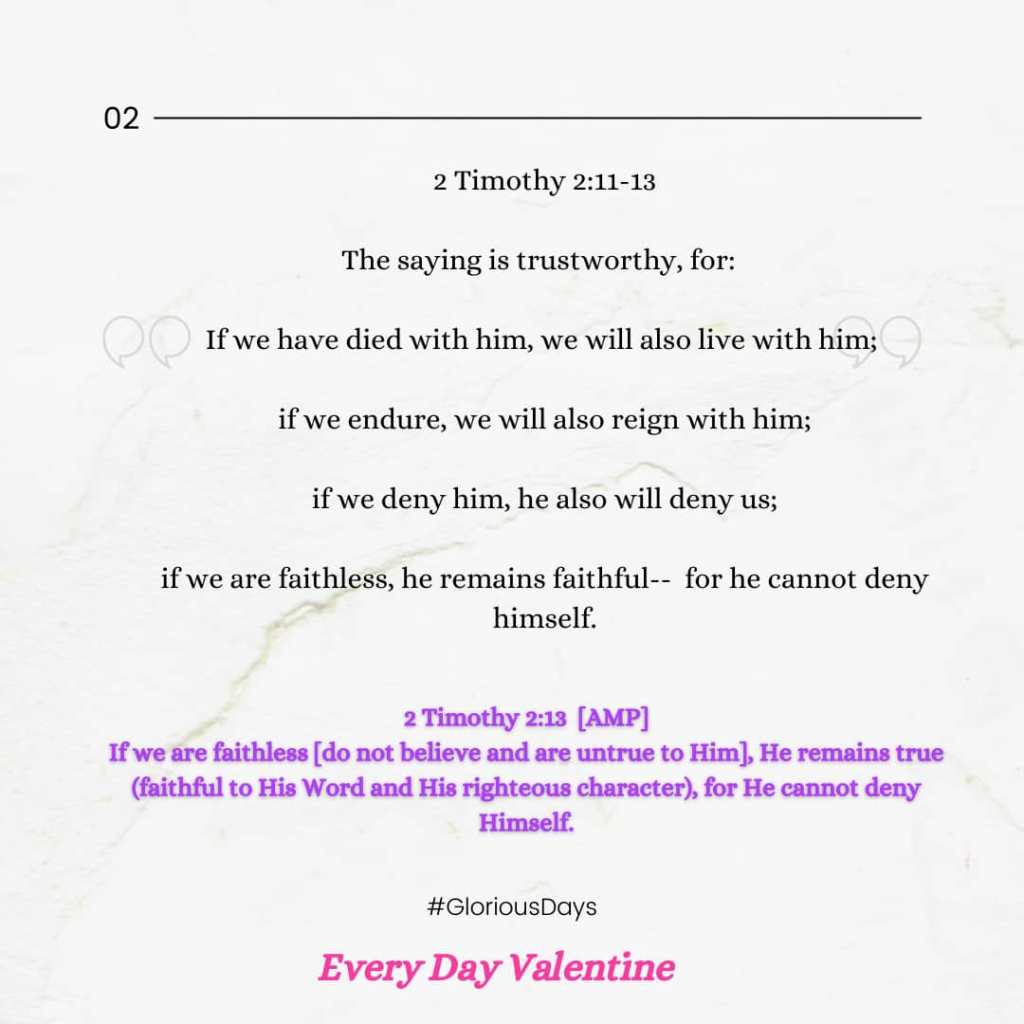
True and worthy of all confidence

When it comes to love, no one says it better than God and no one means it more.

In the first part of our Every Day Valentine series, we talked about a God who loves in spite of and not because of. We looked at Psalm 8; a very beautiful depiction of just how much God loves us. In Psalm 8, David searches for all the reasons why God could even have a slight regard for man; and he finds none. That kind of love totally amazes me.

Today we add another layer to the mystery of God’s love. That God does not just love us, but is also excellent at telling us how much He does, and equally excellent at meaning it. How exhilarating to hear this on Valentine’s Day, the universal day of showing those we love how much they mean to us!

Let me give you a little prologue to the scripture which we are getting ready to read. You know when you receive a text from someone and every additional line is progressively “worse news” than the previous one; and you are expecting the worst possible ending? But Alas… You reach the end of the text and it is as beautiful as an evening sunset at the beach with a cool breeze!

This scripture caught me extremely unawares when I first read it about 10 or so years ago. And it still undoes me each and every time I read it. I just could not believe that such words existed anywhere in the world and that they could be specifically directed to me.

Simply put; in this scripture God is saying, “My darling. My beloved. I will never force myself on you. But the moment you decide to experience my love, everything I have is yours. Wherever you go, you will always come back and find me standing right here; where you left me. I will be faithfully waiting for you.” I liken it to a marriage. God says that even if we go wayward, He will always keep at it. He will stay true to us even when we are galivanting to other places. Even when we do not keep our side of the vow which we earnestly recited on the day when we accepted Him as Lord and Saviour (and the many other days when we renewed that vow); He promises that He will always keep His side of the vow.

The relationship between God and the nation of Israel, as depicted in the old testament, is a perfect illustration of this scripture. When I read the old testament, I cannot help but exclaim at how recklessly in love God is. He stakes everything and never looks back.

Ladies and Gentlemen, here is a true and trustworthy saying. Worthy of all confidence.