The Story I will tell

Everyone who walks with God has a story to tell. The stories may be different but one thing remains true – the experience you get along the journey leaves you with something to tell. Growing up, I thought my story would start on a high note and end like a fairy tale. It is what the preachers said on Sunday or at least the only parts I picked out. ‘Everything will be okay,’ they reiterated to our young and eager souls, a perfect way to keep us on our toes – waiting for tomorrow to come; excited about the beauty it concealed. Then life happened and storms of life hit so hard that they left me wondering if something was wrong with me or with my Faith. My story hit a pause button and I needed more than anything else to find out how other people were fairing – and for those who had made it, how they had avoided these storms and lived to tell their beautiful stories.

Therefore, I picked up my bible and began to go through the pages. And I realised it was full of people going through different stages of life, but they all had one common attribute: This grit like – bordering stubborn – Faith in God. Men like Job who were bold enough to tell God, ‘Kill me if you want, but I am not going anywhere [paraphrase]’. At the end of their lives, each learnt something about God and testified on the same thing: His never-ending Faithfulness to His word and His people. There is a plethora of men and women to write about but today I picked out three of them – all women (we will definitely look at the men another time!). Meet Hagar, Hannah, and the woman with the bleeding disease.

Hagar. We meet her in Genesis and in her story; she starts out as a slave to Abraham and Sarah. When Sarah and Abraham failed to have a child, they resorted to bringing her on board so she could bear a child for them. When she became pregnant, she started to forget her status and overlook her mistress. Sarah would not take it and started to treat her harshly. Unable to endure the harsh treatment, Hagar ran away. She ran into the desert alone and pregnant, unsure of the way to her home. After a long walk and with a lot of despair she rested near a well where an Angel found her. He asked her to go back and submit to Sarah, her mistress and he gave her the assurance that all would be well for her and the son that she would bear, even going as far as telling her that her son would have a great inheritance. What stands out for me is her response; ‘I have now seen the one who sees me (Genesis 16:13); and she gave God a name ‘You are the God who sees‘. Hagar learnt on that day, after years of feeling unseen and unvalued, that God also saw her. There was a God who did not just see her master and mistress, but a God who saw slaves as well! So if Hagar could write her story, it would go: There is a God who sees me even when men do not see me.

Hannah. We meet Hannah in the book of Samuel. She starts out as a barren woman mocked by her co-wife for something that was not even her fault. Her predicament was the same year in and year out, and Hannah was always in tears. One day when she went with her husband to Shiloh to worship, she prayed so fervently that the priest Eli thought she was drunk. However, this time something different happened. Heaven answered! She bore a son, Samuel, who went on to become the voice of God in Israel for as long as he lived. When Hannah came to give thanks, she prayed, He lifts the poor from the dust and lifts the beggar from the ash heap and sets them among princes and makes them inherit the throne of Glory (1 Samuel 2:8)‘. Hannah saw God take a despised barren woman and crown her with His Goodness. So if Hannah could write her story, it would go: There is a God who lifts us up, takes away the shame and pain, and fills us with laughter.

The woman with the bleeding disease. Her story is found in the gospel of Matthew, Mark and Luke. None of them is kind enough to tell us her name. All they say is that she had a bleeding disease for 12 years. One day she got the news that Jesus was coming to town and she joined the crowd coming to see him. Her Faith propelled her to touch Jesus’ cloak and when she did, she was healed immediately. Jesus then turned around and asked, ‘Who touched me?’. After a short search, she came forward and he told her; Daughter, your Faith has made you well. Go in peace (Luke 8:48)‘. For many years, this woman’s identity and her story were tied to her disease, unable to even go to the temple. She was only one thing: the sick bleeding woman. However, that day Jesus called her something else: Daughter. Her Faith not only healed her but also led her to understand that her identity was not that of the sick bleeding woman, but she was a child of the most high God. So if this unnamed woman could write her story, it would go: There is a God who calls me His own.

Hagar’s story starts as a slave, Hannah as a barren woman and the woman with a bleeding disease without an identity. And yet they are the ones we read about today; who give us hope that our stories can change and they can end well. Studying these people’s stories helped me understand how I will tell my own story. That at every stage of life, God stayed Faithful and that the areas that caused me the most pain and shame – stories I wish were never known or told – that is where God started from. He started to mold and like the perfect molder He is, I trust He will make something beautiful out of my life. I will write that: when I was weak, I was made strong; when I was poor, I was made rich – for that is what the Lord has done for me. Therefore, when I tell my story, it will not be from a weak, shameful, and defeated perspective; but it will be full of the times when God came through.

The story I will tell will be of a God who stayed Faithful – even to me.

A perfect God meets a “tough-to-describe” young woman

This year’s valentines was the best valentines I had ever had. No I did not receive flowers, and no – there was no candle lit dinner. But there was something particularly beautiful about this valentines. For the first time, in years, I had come to a full realisation of how much I was valued, and how much I was loved by God. It finally occurred to me that I could indeed be God’s Masterpiece. I looked through the canvas of my life and saw an Artist at work. I saw mistakes which had been turned into miracles, disappointments which had been turned into appointments, tears which had been turned into laughter – but more so, I saw a loving hand weaving through every facet of my otherwise tumultuous life.

Therefore, as the 14th day of February 2021 approached, I wondered how I would celebrate my renewed perspective on life, my new found joy and the miraculous fulfilment that I felt deep down in my soul. What better way than to show some Holy PDA by sharing scriptures and portions of the Bible which assure me of God’s profound love for me?

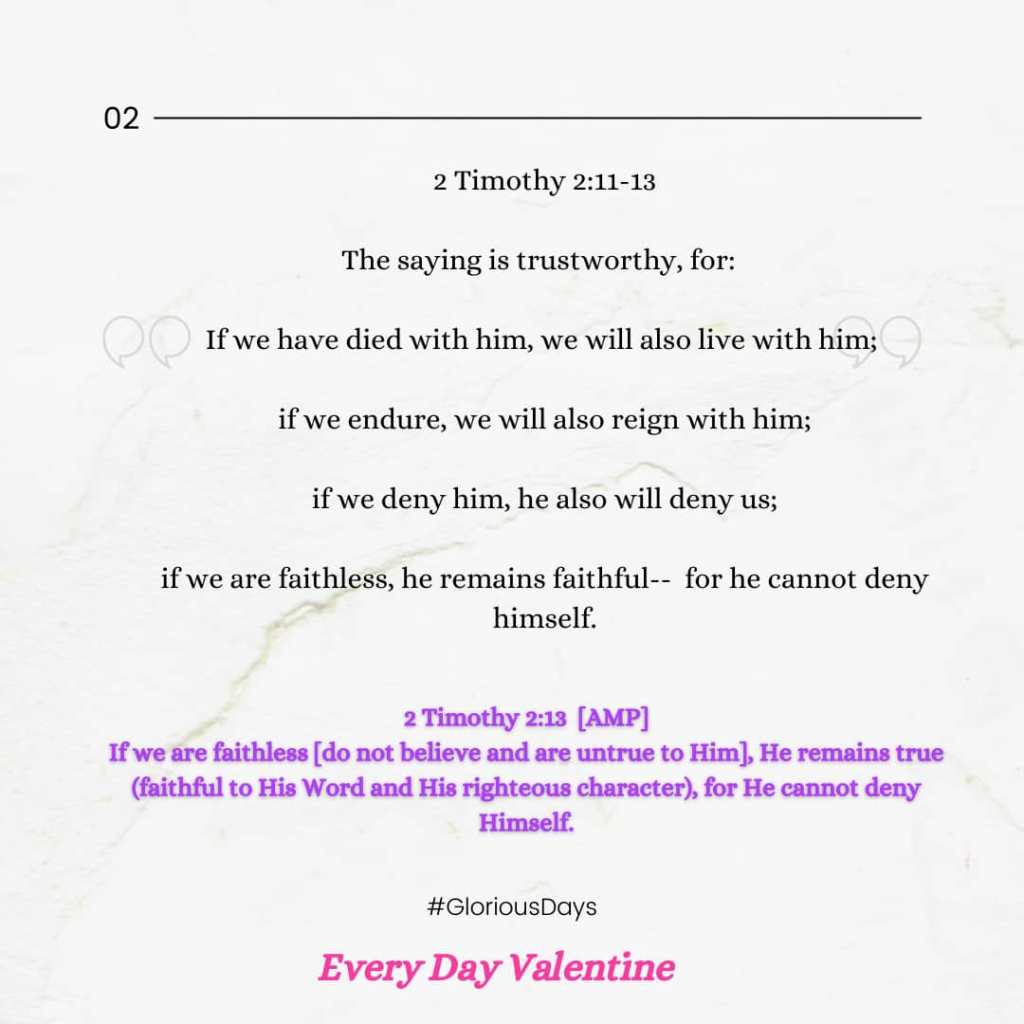
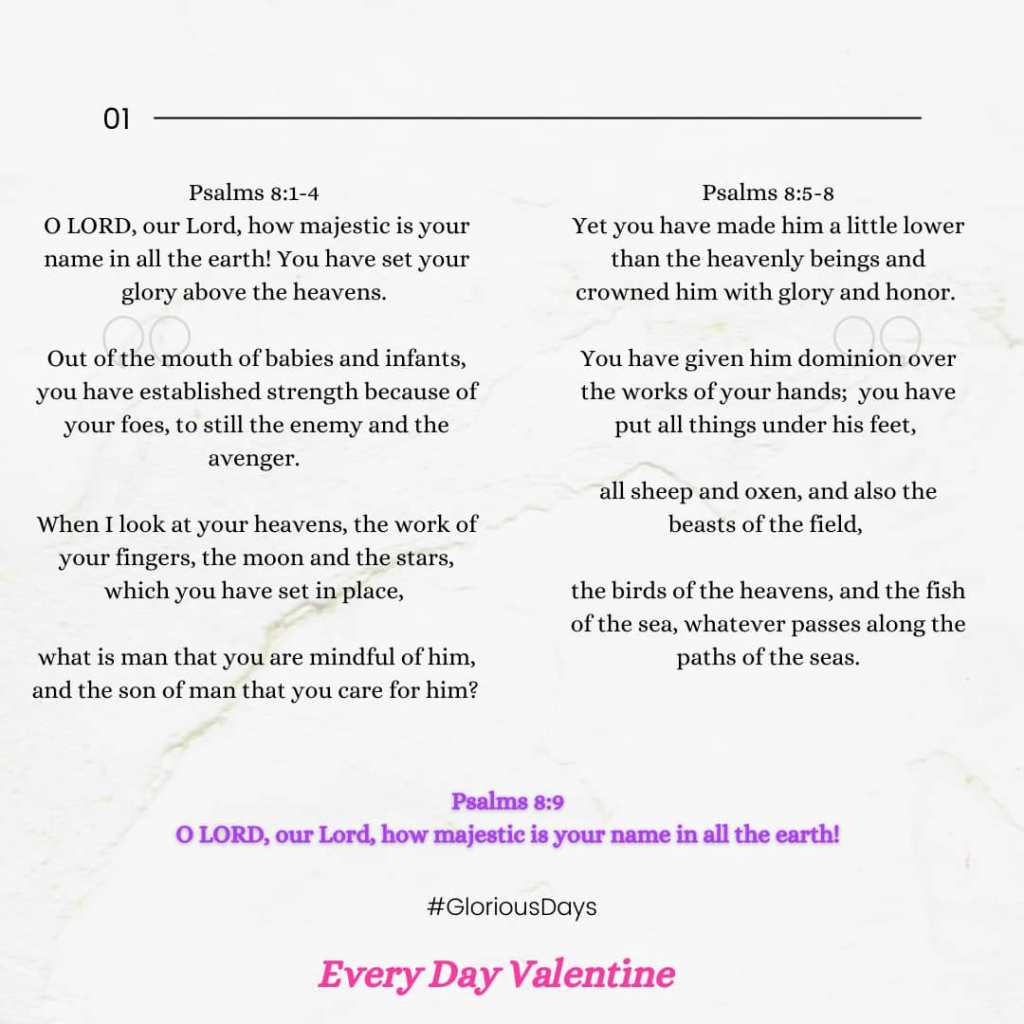
The revelation of God’s love is one of the most important revelations a Christian will have on this other side of eternity (Ephesian 3:14-21). This is because without a deep understanding and a wholesome acceptance of God’s love, we will always find it hard to trust God. Lack of trust (that is lack of faith) poses a great problem because the Bible says that, “without faith, we cannot please God (Hebrews 11:6)” – and yet the joy of the LORD is our strength (Nehemiah 8:10). Everything then revolves around our perception of, and appreciation, of God’s love. So, in this 3-part series, which I have affectionately called Every Day Valentine, I will talk about some of the scriptures which touch my heart with the love of God and why they do so. Let’s get into this.

In all honesty, I do not think today’s scripture has the sort of wow factor to it in the sense that I, a human being, would understand a wow factor. For a long time it was just one of the many scriptures I knew and referred to every now and then. But then, towards valentines day, I started to really meditate on it – sometimes unconsciously. And wow! As I was meditating on it, my spirit understood it, my heart felt it and my body accepted it.

You see, meditation to me can best be illustrated by the way a relationship between a man and a woman starts. First, the man declares his affection for the woman. More often than not, the woman has no reciprocal feelings for him and he has never crossed her mind, even as a last resort. However, she makes a slight but potentially dangerous mistake – she continues to entertain him, listen to him and she keeps him around. Then before she knows it, her heart is hooked. And alas! She falls in love with him.

If men, flawed as they are, are able to do this? How about God? If entertaining and listening to a mere mortal man can cause you to fall in love with him and develop feelings for him that were previously non-existent, how about entertaining the Holy Spirit? How about paying attention to the Word – Christ? How about spending time with the Father – God? The Bible is not kidding or suggesting “out-of-reach” methods when it urges us to meditate. Let us make it a point to meditate on the word of God everyday.

Back to the major purpose of this blog. The scripture I am about to present to you gives me the sort of feeling you get when someone you love genuinely (and generously) says “I love you”. To put it in simple terms, this scripture satisfies every longing. It reminds me that there is one who loves me in spite of, and not because of. I pray that you feel the same way when you read it.

Jjaaja Nancy – Tale of a hidden figure

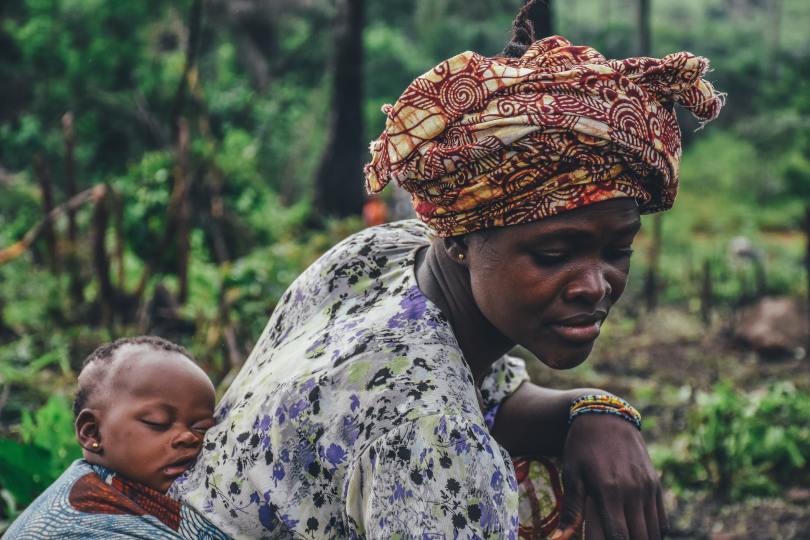
When you go to our village down there in Namawondo, Kibuku district in Uganda, you can stop at the trading center and ask anyone; whether it the village shopkeepers, the chapati* sellers on the roadside, or the boda-boda* men on the stage; for the home of Mzee* Yonah Mbayo, and someone is bound to know the place. “Yes, Mzee Yonah. I know him. He was a good man. Follow this road, turn right at the junction and you will find a muvule tree. That is the home of Mzee Yonah,” they will say while pointing at the road which leads to my grandfather’s compound. That is all they know about this great man who made his home thrive, brought up his children well, and served the village as a Mwami (Local Counsellor 1).  My grandmother Nancy or as we call her Jjaaja Asanasi is only mentioned as one of the many wives Mzee Yonah had.

What many in the village do not know or fully appreciate is the tremendous role Jjaaja Asanasi played in the family. Our grandfather was a great man and we are glad to be part of his family, however I have come to learn that his story and our stories are not complete without Jjaaja Asanasi. Although she lived in a time when women got very little recognition in the community, she lived a life worth celebrating. Like most in her time, she never went to school but somehow had the wisdom to send all her children to school. When Mzee Yonah said he was running low on funds and could only afford to send the boys of the home to school, she dug her back to sickness to raise money in order to take the girls to school so that they too could have a chance at the white man’s education.

One thing that stands out about Jjaaja Asanasi, and which I will always cherish and be grateful for, is her heart. In all my time on earth, I do not think I have met someone with a kinder heart than Jjaaja Asanasi. Jjaaja really took to mind Paul’s exhortation that everything should be done in love and that we should never repay anyone evil for evil. Life with co-wives and overly demanding in-laws is never easy, but if it came to it she would let them eat all the food she dug up from the garden, while always reminding her children (and herself) that tomorrow would take care of itself. When we the close family noticed people were taking advantage of her and manipulating her, we did what we thought was wisdom on our part by warning her against such people. However, her response was always the same, “Leave them. Do not let their bad hearts corrupt you. Do good because that is who you are”.

Jjaaja got saved at a later stage in her life, that is in her 60’s. However, she made up for all the time with God she never had in her youth. She never stopped thanking God for life, for all his goodness, or for saving her. Her last contribution to the body of Christ was approving the construction of a church, called Redeemed church, on a piece of land which she owned. All her savings went to the construction of that church. “Take this. Is it enough to pay for a window in the church? Take this too and send it to the pastor. He may not have food for his family,” she would often direct us, as she handed over a bundle of money from her safe. When there was hesitation from us, she would remind us that God had given her the opportunity to serve Him at her old age and then she would gently urge us to do as she bade us.

In her last days, her health deteriorated greatly and she could not walk on her own. She spent most of her time indoors between the sitting room and bedroom, but she never left her radio behind wherever she went. She always had to tune in and pray along with Pastor Bujingo; not for her health, but for her children and grandchildren. “May Matilda be well, may Innocent do well at work, and may Solomon finish school well and get a job…”, we often heard her mumbling this and so much more.

There is much to say about Jjaaja Asanasi. This is only a sneak peek into the numerous ways she blessed us. She was in many ways a hidden figure, always working selflessly and tirelessly in the background of her children’s and husband’s lives. If our stories are ever written and our lives talked about, I hope it will be remembered that our story, my story started with this phenomenal woman. A woman who lived by one simple principle, “love is the only way”.

Meaning of some local words used in the text:
* Chapati – Chapati is the local name for roti, an unleavened flat bread originating from India
* Boda-boda – In Uganda, boda-bodas are motorcycle taxis which carry one or two passengers
* Mzee – This is a local word used to address an old man. It shows respect and reverence for the old man
* Jjaaja – A local word used for addressing a grandmother or grandfather

God of the Big Picture

Today I was studying the book of Ruth and something caught my eye which I had never noticed before. When Ruth got married to Boaz, she conceived and gave birth [almost] immediately (Ruth 4:13). That made me wonder, “Wasn’t Ruth married to Naomi’s son, Mahlon, long enough to have children?” Indeed, when I turned back to Ruth 1, I discovered that the two were married for at least 10 years by the time of Mahlon’s death (Ruth 1: 4-5). The big question then is, “Why?”

Was it for the lack of trying that Ruth did not give birth all those 10 years? Or was it for the lack of interest in having children. My answer to both questions is “No”.

First of all, I say no because Ruth lived between the 4th and 6th Century BC (rough estimate from a quick Google search). During this time, the role of a woman was generally to tend the home and to bear children. Furthermore, “Reproduce and fill the earth” was still a very serious commitment at that time (since the earth was not full at all anyway). Therefore, we cannot say that Ruth and Mahlon were not trying. We also cannot say that they were not interested. Ruth in particular had become really close to this family and from the story, we can see that she desired nothing but to please her mother-in-law, Naomi. Ruth must have been truly interested in having children in order to carry on the family name and so was Naomi and Mahlon.

If Ruth and Mahlon were interested and were trying; and we know from the story that Ruth was not barren [I have thought for a second that Mahlon was the one who could not have children, but I will disregard that thought because there is no precedent in the Bible, that I know of, to indicate that the problem was with the man]. If all of the above was the case, why then didn’t Ruth have children for all the 10 years she was with Mahlon?

Could it be that the delay in childbirth was allowed by God? Could it be that God saw the bigger picture, where one day Ruth would have to go to Bethlehem as a widow and would need a kinsman redeemer?

Let me take a step back and explain myself. When Boaz was having that meeting with his relative and the clan elders in Ruth 4:1-12, he made this statement twice, “[Buy Ruth along with Elimelech’s other possessions]…. in order to perpetuate the name of the dead in his inheritance”. This means that the major reason (probably only reason) that Ruth was even a part of this [kinsman redemption] transaction is because she had no children with Mahlon and thus it was justified for Boaz to marry her as part of the redemption – so as to preserve Mahlon’s and Elimelech’s lineage.

This is quite profound. If we step back 10 years from the time Ruth gave birth to her first child, we would meet a woman who did not know anything about the bigger picture. A woman who in that moment only thought about the fact that she could not have children and wondered desperately why this was so. She probably prayed earnestly to God; starting every year believing and hoping that it was the year she would conceive and ending the year crushed with disappointment.

Leaving the past and fast forwarding 10 years later, I can imagine Ruth seated at the makeup table on a her wedding day, looking back at the 10 years of disappointment and this time not with despair but with a knowing smile. Understanding finally that God’s delay was indeed not a delay. It was preservation.

I see her holding the beautifully embroidered fabric of her wedding dress; her mind flooded with the light of understanding. The Master had been interweaving a beautiful story behind the painful piercing of failure and disappointment.

On that day, and most profoundly on the day she gave birth to Obed, Ruth understood the God of the Bigger Picture.

2 Peter 3:9 The LORD is not slow in keeping his promise, as some understand slowness. Instead he is patient with you, not wanting anyone to perish, but everyone to come to repentance.

Why I believe in Jesus

There is a verse that always comes to my mind when I hear a “why” question about the Christian faith. It’s 1 Peter 3:15b, “… always being prepared to make a defence to anyone who asks you for a reason for the hope that is in you…”. The first century church faced this question so much so that Peter had to caution his readers to be prepared always to make a defence – to give a logical, reasonable and compelling answer to why they believed in Jesus. A lot has happened since Peter wrote his letter and several decades have passed, but the instruction is still as relevant today as it was then. Whereas Christians in the early church faced completely different challenges (and sometimes more life – threatening) than what we face in current times, the question for which non-believers demand an answer is still the same – “why?”. I hope I can give you, if not a logical, then at least a reasonable and compelling defence for the hope and faith I have in Jesus Christ.

I gave my life to Jesus in my first year of high school. I was 13 then. I was simply attracted by the funny and articulate preachers who came to school and the day I gave my life to Jesus; a group of students had just finished acting a skit. I do not remember a line in the skit but as the last scene was being rolled off the stage, I said in my heart, “I want to be a part of this. I want to be this happy and joyful. I want to have this kind of meaning.” So when the preacher invited those who wanted “to get saved” to come forward, I stepped to the aisle without any hesitation and walked to the altar. I mumbled a few words which I don’t recall and started what has so far been the most long lasting, fulfilling and meaningful relationship in my life.

When I stepped on to that aisle, I did not know what I was signing up for. I did not know a thing about what my future held. I had been a “Christian by association [read birth]” for 13 years, never knowing what it really meant to profess Christianity. It’s been several years since I last walked down that aisle and now I know for sure what I signed up for. It is exactly what I had hoped for – happiness, joy and meaning. I have seen changes in and around me over the years that could have only been possible through the working of a being much more powerful than the forces of nature (including my nature). I have gone through experience upon experience that have sealed the deal for me and have confirmed to me – over and over again – that the decision I made on that sunny afternoon in a high school chapel was the best decision in my life.

When I think of the reason for my faith and hope in Jesus, I am immediately reminded of Jacob. My favourite portion from the book of Genesis comes from Jacob’s monologue in Genesis 28:20-22. However, today I would like to tell you about two other things Jacob said [at the end of his life] which to me best explain why I believe in Jesus. In Genesis 47:9 Jacob answers Pharoah by saying, “my life of wandering has lasted a hundred and thirty years. Those years have been few and difficult [some versions say evil], unlike the long years of my ancestors in their wanderings.”. When one reads these words [alone], they can be tempted to quickly conclude that a life with God is worthless, difficult, short, painful and pointless. But the same Jacob comes back in Genesis 48:15 and says, “…the God before whom my fathers Abraham and Isaac walked, the God who has been my shepherd all my life long to this day, the angel who has redeemed me from all evil…”.

Upon reading the two scriptures together and with some knowledge of the background and past events in Jacob’s life, it is very clear that when Jacob answered Pharoah in Genesis 47, he was not speaking about God. He was speaking about his life and his choices which had gotten him into a bitter fight with his brother Esau and had sent him on a painful life with an uncle who did not care about him. It even becomes clearer when Jacob declares in Genesis 48 that God had been with him as he was with his ancestors, that God had been his shepherd (I encourage you to go and find out what the work of a shepherd was during those times) and that God had redeemed him from evil (permit me to add – the evil which he got himself into).

Several years after Jacob said these words, one of his descendants had the same conviction about God. Although this descendant had often laboured to keep himself from evil, evil was always lurking around him and stalking him on every side. But his testimony about God is very consistent with Jacob’s testimony in Genesis 48. I wonder if when penning the glorious words in Psalm 23, David remembered his ancestors as Jacob did.

Several centuries after David penned that beautiful Psalm, another of the descendants of Abraham, one whose life is more akin to Jacob’s experience than to David’s. One to whom evil has not shied away and who occasionally, like Jacob, finds herself entangled in places, decisions, experiences she should not be in. Several millennia later, that [adopted] daughter of Abraham has the same conviction.

God [the Father] is Faithful. God [the son – Jesus] is Faithful. God [the Holy Spirit] is Faithful. That is why I believe in Jesus. He is faithful to the poor. He is faithful to the rich. He is faithful to the happy. He is faithful to the broken hearted. He is faithful to the sinner. He is faithful to the righteous. He is faithful to children. He is faithful to parents. He is faithful to kings. He is faithful to servants. God is Faithful yesterday, today and forever!

The story of the cross is a story that explains and affirms one thing – the faithfulness of God. That is why I believe in Jesus!

Scriptures Quoted but not included within the text

Genesis 28:20-22 (ESV) Then Jacob made a vow saying, “If God will be with me and will keep me in this way that I go, and will give me bread to eat and clothing to wear, so that I come again to my father’s house in peace, then the LORD shall be my God, and this stone, which I have set up for a pillar, shall be God’s house. And of all that you give me I will give a full tenth to you.”

Psalm 23 (ESV) The LORD is my shepherd; I shall not want. He makes me lie down in green pastures. He leads me beside still waters. He restores my soul. He leads me in paths of righteousness for his name’s sake. Even though I walk through the valley of the shadow of death, I will fear no evil, for you are with me; your rod and your staff they comfort me. You prepare a table before me in the presence of my enemies; you anoint my head with oil; my cup overflows. Surely goodness and mercy shall follow me all the days of my life, and I shall dwell in the house of the LORD for ever.